AI-Enhanced Cyber Defense: Rebalancing the Scales Against Adversaries
The Shift in Cyber Defense Dynamics
In contemporary cybersecurity, the dialogue often centers around artificial intelligence as merely a tool for automating traditional processes, but this perspective misses a vital development. The real evolution occurs when AI collaborates with threat intelligence, drawing insights not only from attacker methodologies but also from the vulnerabilities inherent in an organization's defenses. This synergy presents a transformative approach to strengthening defenses, contributing to a more balanced power dynamic between attackers and defenders.
The Landscape of Cyber Defense
The quintessential challenge in cybersecurity lies in the inherent asymmetry: defenders are overwhelmed with the need to secure every possible entry point, while attackers require just one exploitable vulnerability. Various constraints—such as budget limitations, compliance necessities, and the imperative of maintaining system uptime—further complicate defenders' roles. Conversely, attackers can afford to be patient and strategic in their approach.
Automation: Enhancing But Not Transforming
A significant aspect of AI's current contributions to cybersecurity involves automating tasks such as alert triage, faster incident response, and enhanced analytical capabilities. Although these improvements are commendable, they are essentially extensions of existing workflows and do not fundamentally alter the defensive framework. The integration of AI into threat intelligence, however, has the potential to redefine operational capabilities.
Where AI Meets Threat Intelligence
The most critical advance lies in the convergence of AI and threat intelligence—units that reason over real-time attack patterns alongside organizational defenses. This integration may lead to capabilities previously thought unattainable, directly influencing how organizations manage their cybersecurity efforts.
Mapping Threats to Vulnerabilities
Historically, threat intelligence reports provided helpful insights, detailing adversarial tactics and vulnerabilities. Yet, acting on that information typically required labor-intensive manual assessments by analysts to correlate those tactics with current infrastructure. Now, AI can continuously analyze and cross-reference new threat reports against an organization’s live infrastructure, providing prioritized assessments of actual risks, making the response not just reactive but strategically proactive.
Bridging Offense and Defense
A long-standing challenge in cybersecurity has been the separation of external threat intelligence from internal vulnerability assessments, leading to siloed information that was reconciled too infrequently. With AI, these two streams can be integrated, offering a comprehensive view of how an attacker's capabilities intersect with an organization's weaknesses. This continuous perspective enhances operational readiness and shifts the analytical burden from manual tasks to dynamic models.
Predictive Risk Assessment
In the past, patch prioritization often relied on theoretical severity ratings, like CVSS scores, which inadequately accounted for actual threat landscapes. AI facilitates a more nuanced prioritization method, using real-world exploitation data to reorder vulnerabilities based on current adversary behavior and exposure levels. Organizations can now focus their patching efforts on the most pressing vulnerabilities rather than simply addressing those flagged as severe.
Contextual Threat Analysis at Scale
Rather than correlating disparate events against predetermined rules, AI can synthesize data from various sources to render holistic judgments. This ensures that responses are informed not only by situational anomalies but also grounded in the specific methodologies associated with current threat actors, thereby improving the precision and relevance of detection mechanisms.
Dynamic Attack Path Analysis
Traditional assessments of vulnerability are often periodic, but AI can maintain a living model of potential exploitation pathways. By continually updating based on evolving conditions and threat intelligence, organizations gain a fluid understanding of their exposure, allowing them to adapt defenses in real time rather than in reactive cycles.
Anticipating Adversarial Moves
During active incidents, human analysts often rely on their past experiences with attackers to predict their next steps. AI models, equipped with threat intelligence and historical attack data, can replicate this cognitive process, resulting in more effective incident responses and proactive defenses.
Implementing Deceptive Strategies
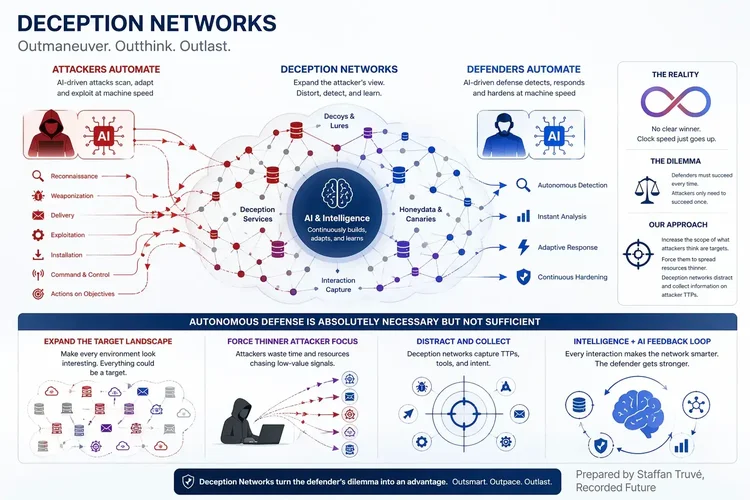
While the previous strategies enhance defensive operations, the combination of AI and intelligence also opens avenues for offensive strategies that mislead adversaries. By creating dynamically adaptive deception environments, organizations can better conceal true assets from skilled attackers.
Evolution from Static to Dynamic Deception
Although systems like honeypots have existed for years, they typically fail because of their static nature. AI transforms this landscape by generating decoy systems that adapt based on attacker behavior, maintaining credibility while diverting malicious activities.
Smart Placement of Deception Tools
This strategic deception leverages real-time intelligence to position traps in the most likely pathways of attack, shifting the balance in favor of defenders. A decoy credential might mimic particular service attributes that adversaries commonly target, thereby enhancing the effectiveness of the deception.
Cost Imposition on Attackers
The pervasive use of AI-generated deceptions not only complicates the attacker’s mission but also imposes additional costs and risks. As attackers navigate through layers of deception, their confidence erodes, ultimately playing into the defenders' hands.
Engaging with Attackers
One of the more innovative aspects of AI within deception frameworks is enabling interactive engagement with adversaries, transforming passive traps into active intelligence-gathering operations. This provides invaluable insights into attacker techniques, which can feed back into refining both defense and deception strategies.
Broadening Accessibility to Intelligence-Driven Defense
A noteworthy effect of AI in cybersecurity is that it democratizes access to intelligence, reducing the skill gap. When team members can easily query their environment for vulnerabilities concerning specific threat groups, the operational model shifts, allowing the entire security team to operate with greater efficacy.
Transformative Implications for Cybersecurity Strategy
AI's capability to integrate offensive and defensive intelligence changes the nature of cybersecurity management, allowing organizations to combat threats effectively without real-time expertise. The traditional dichotomy of “defenders versus attackers” evolves into “AI-aided defenses versus non-AI strategies.” Organizations embracing AI in their cybersecurity frameworks may find themselves gaining strategic parity against threats like never before.
Looking Ahead
The emergence of autonomous AI agents introduces a new complexity to the cyber battlefield. Defenders will need systems capable of not just acting on threat intelligence, but autonomously assessing and responding. The implications for governance and control are significant and merit immediate attention.
As this technological landscape shifts, the risks of adversarial countermeasures also escalate, necessitating rigorous validation of intelligence. Ultimately, while the age of significant asymmetry persists, the fusion of AI and threat intelligence invites organizations to not just react, but to assert control over their cybersecurity destinies.