High-Impact Vulnerabilities Identified in April 2026: Prioritization for Remediation
In April 2026, the Insikt Group® reported the identification of 37 high-impact vulnerabilities that require immediate attention, with a striking 35 of these achieving a Very Critical Recorded Future Risk Score. This marks a notable 19% increase compared to the previous month.
Overview of Vulnerabilities
A significant majority, 31 of the 37 vulnerabilities, were included in the US Cybersecurity and Infrastructure Security Agency (CISA)’s Known Exploited Vulnerabilities (KEV) catalog. Notably, six vulnerabilities emerged solely from honeypot data, accessible only to Recorded Future customers. This indicates not only a growing number of exploitable vulnerabilities but also the complex web of data sources necessary for understanding these threats.
The vulnerabilities reported span a wide range of products from 23 different vendors, underscoring a systemic issue that transcends any single organization or platform. Microsoft is particularly affected, accounting for roughly 22% of the total vulnerabilities identified. This heavy concentration on one vendor signals potential weaknesses inherent in their software ecosystem, raising questions about the resilience of widely used enterprise products against emerging exploits.
New Vulnerability Detection Measures
The Insikt Group has also developed Nuclei templates for specific vulnerabilities, particularly for the missing authentication issues found in Nginx UI (CVE-2026-33032) and Marimo (CVE-2026-39987). These templates are exclusively available to clients of Recorded Future, which raises the stakes for organizations that are not on board with the latest threat intelligence offerings. Typically, organizations without access may find themselves at a disadvantage, lacking crucial early detection capabilities for these serious vulnerabilities.
Active Vulnerabilities of April 2026
As reported, all 31 well-documented vulnerabilities below faced active exploitation during April 2026. This excludes the six CVEs sourced from honeypot activity. The table highlights public proof-of-concept (PoC) exploits found by Insikt Group®, though users should independently verify their effectiveness.
Score
✓
(exclusive for Recorded Future Customers)
Table 1: A summary of vulnerabilities actively exploited in April, based on data from Recorded Future (not including honeypot-derived CVEs).
Key Trend Observations for April 2026
- Seven vulnerabilities from the report were associated with ransomware activity:
- Six were linked directly to the Storm-1175's Medusa ransomware operations.
- CVE-2026-41940 was also identified by CISA as used in known ransomware scenarios (specifically the Sorry Ransomware).
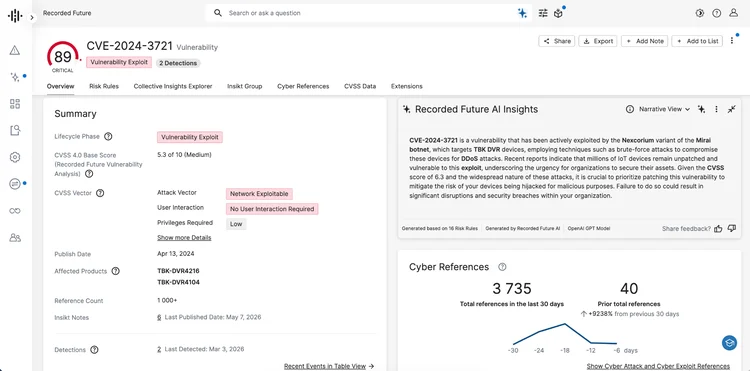
- In another case, CVE-2024-3721 on TBK DVR devices was exploited to deploy the Nexcorium botnet.
- Sixteen of the vulnerabilities enabled remote code execution (RCE), impacting products from a variety of vendors including Adobe and Microsoft. This widespread vulnerability undoubtedly poses significant risks for enterprises globally, making it imperative for security teams to address these issues immediately.
- Insikt Group® reported public proof-of-concept (PoC) exploits for 24 of the listed vulnerabilities. This is a double-edged sword; while it highlights potential attack vectors, it also serves as a clear indicator that malicious actors are actively exploiting these security gaps.
- Path Traversal (CWE-22) was the most common vulnerability, followed by Code Injection (CWE-94) and Improper Input Validation (CWE-20). The prevalence of these specific vulnerabilities suggests that developers may not be incorporating sufficient security measures in their coding practices.
- Some vulnerabilities date back more than five years, with the oldest being around seventeen years old; a testament to ongoing exploitation of older weaknesses. This reveals a troubling trend: organizations often fail to patch long-standing vulnerabilities, which continually puts them at risk long after a fix could have been implemented.
Targeted Exploitation Analysis
Focused attention on specific high-impact vulnerabilities this month revealed links to known threat actor campaigns, those with public PoC exploits, and those for which the Insikt Group® has provided detection templates. Essentially, these vulnerabilities don't just exist in a vacuum; they link back to a myriad of malicious activities conducted by cybercriminals. If you’re working in this space, you know that such relationships can offer insights that are invaluable for threat actors looking to mitigate risks.
Attack Campaigns Targeting TBK DVR Vulnerability
On April 17, 2026, FortiGuard Labs reported a campaign exploiting a vulnerability in TBK Digital Video Recorder (DVR) devices, leading to the delivery of Nexcorium, a variant of the Mirai botnet. This OS command injection vulnerability, CVE-2024-3721, allows remote attackers to execute commands on affected systems. It represents just one instance of a broader trend where vulnerable devices are increasingly being hijacked for large-scale attacks.
FortiGuard's analysis detailed how attackers exploit CVE-2024-3721 via manipulated requests to deliver malicious scripts, highlighting the need for immediate remediation measures. Those in IT security circles should prioritize addressing such vulnerabilities before they're exploited into a full-blown crisis. Additional technical insights and indicators of compromise (IoCs) are accessible to Recorded Future customers through comprehensive reports, resources crucial for preemptive measures.
For further insight, Recorded Future clients can utilize Malware Intelligence features that reveal samples connected to documented network indicators. (And this is the part most people overlook.) Having access to this intelligence can make all the difference when it comes to staying ahead of cyber threats.
Implications and Future Outlook
The implications of these vulnerabilities extend far beyond individual incidents. As we've seen, a disproportionate number of these vulnerabilities arise from long-standing software that hasn't been updated. This is symptomatic of a larger issue in software maintenance and security protocols across many organizations. With increasing cyber threats, particularly from ransomware groups, defenders must enhance their vigilance.
What this means for you is multi-faceted. For organizations, the pursuit of a holistic cybersecurity framework may be the best course forward. It’s more than just patching vulnerabilities; it’s about fostering a culture of security awareness among employees, implementing automated systems for vulnerability management, and staying informed about the latest threat intelligence. The challenges are daunting, but overlooking them only sanctifies the growing list of exploitations.
As more vulnerabilities surface, the roles of threat intelligence and tailored remediation templates become central. Companies that invest in proactive measures will likely find themselves better positioned to mitigate risks before they can be exploited. However, this proactive stance requires commitment, resources, and an ever-watchful eye on emerging threats. In this context, it's not sufficient to react; organizations must also prepare to anticipate, adapt, and respond effectively to the evolving threat environment.