Critical Vulnerabilities Surge in March 2026, Ransomware Groups Target Cisco Systems
March 2026 witnessed the identification of 31 high-impact vulnerabilities, underscoring the persistent threat environment that enterprises continue to navigate. Of these vulnerabilities, an alarming 29 received a Very Critical Risk Score from Recorded Future, signifying the urgent need for remediation efforts. This month's findings particularly highlighted the risks faced by major industry players like Cisco, Microsoft, and Apple, which collectively accounted for about 32% of the vulnerabilities detected. Such a concentration suggests that even the biggest names in technology aren't immune to serious security flaws, raising concerns about the efficacy of their security protocols and patch management strategies.
Old Flaws, New Exploits
Among the vulnerabilities spotlighted was CVE-2017-7921, a near-decade-old flaw in Hikvision's products. Its persistence in exploitation underscores a troubling reality: attackers often focus on long-standing vulnerabilities lurking in environments where patching and updates are inadequate. This reveals a glaring issue in many organizations’ security postures; they often prioritize newer vulnerabilities while neglecting those that, although old, remain exploitable. Ignoring these outdated vulnerabilities can leave companies open to attacks that could have been easily mitigated with timely updates. Organizations, therefore, need to prioritize remediation based on active threat intelligence, evaluating risk based on potential exploitability rather than the age of vulnerabilities.
Emerging Challenges in Vulnerability Management
This month's analysis recognized Nuclei templates for serious vulnerabilities such as a path traversal issue in MindsDB (CVE-2026-27483) and a critical missing authentication flaw in Nginx UI (CVE-2026-27944). Insikt Group made a notable observation that public proof-of-concept (PoC) exploits were available for 10 of the 31 identified vulnerabilities. This opens the door for less sophisticated attackers to exploit these vulnerabilities without the requisite knowledge typically needed. It’s clear organizations must be proactive in scrutinizing their assets, developing streamlined response plans tailored to active exploits that threaten their operational integrity.
Vulnerability Impact Overview
The vulnerabilities listed below were actively exploited in March. Each entry includes relevant public PoCs, although caution is advised when testing these exploits for accuracy.
Score
Table: Summary of vulnerabilities actively exploited in March as reported by Recorded Future.
Significant Trends in Exploitation
- This month saw a notable incidence of vulnerabilities related to CWE-502 (Deserialization of Untrusted Data) and CWE-94 (Code Injection). The prevalence of these particular types of issues might suggest that attackers are focusing on easy pathways into system vulnerabilities that circumvent traditional access controls.
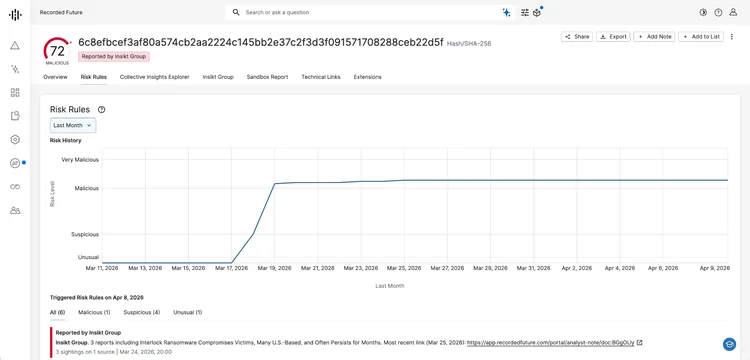
- The Interlock Ransomware Group's operations showcased a concerning trend: they exploited a zero-day vulnerability in Cisco's FMC, which was part of a larger enterprise network compromise scheme. This reflects a shift toward targeted exploitation strategies that prioritize vulnerabilities before they are publicly disclosed, presenting a significant threat to organizations across various sectors.
- The attackers leveraged CVE-2026-20131, allowing them to execute arbitrary Java code on compromised devices—a move that speaks to their tactical sophistication and resourcefulness.
- This targeted operation was reportedly underway for several weeks prior to the public disclosure of the vulnerability, illuminating the critical need for timely patching and threat intelligence sharing across the industry.
- Additional malware campaigns concentrated on exploiting vulnerabilities in iOS platforms, where various malicious payloads led to widespread device manipulations, creating chaos among users and businesses alike.
- Nine identified vulnerabilities permitted remote code execution, primarily targeting platforms like Google, Microsoft, and others—a sure sign that the traditional defenses may be faltering against modern attack methodologies.
Case Study: Interlock Ransomware Tactics
The exploitation of CVE-2026-20131 by the Interlock Ransomware Group stands as a significant attack vector with substantial implications for enterprise security. As outlined on March 18, 2026, the vulnerability affects the Cisco Secure Firewall Management Center, enabling unauthenticated access that allows attackers to execute root-level Java code with alarming ease. This calls for serious introspection about existing cybersecurity measures.
After breaching the system, attackers deployed ELF binaries from a specified staging server to facilitate further operations. This included lateral movement within the compromised networks, raising the stakes for affected enterprises. Their toolkit reportedly features a mix of Java-based and JavaScript-based Remote Access Trojans, showcasing a level of technical cunning that can evade traditional security systems. The implications are dire.
Insights gathered from a screen locker sample shared by Amazon Threat Intelligence unveil attempts by the attackers to manipulate victim machines for both evasion and reconnaissance purposes. The malicious sample, identified through sandbox analysis, revealed a series of obfuscation tactics aimed at avoiding detection within affected environments. (And this is the part most people overlook: the cat-and-mouse game between attackers and defenders is more complex than ever.)
As organizations continue to grapple with diverse vulnerabilities, a strategic focus on timely patching and robust asset management is essential in thwarting potential ransomware threats and broader cyber exploitation strategies. If you're working in this space, acknowledging the shifting tactics of cybercriminals is non-negotiable. What’s evident here is that a proactive security posture that anticipates rather than reacts is vital for safeguarding assets in an increasingly hostile digital environment.
Future Outlook and Implications
The events of March 2026 reflect a noteworthy shift in how vulnerabilities are treated within organizations. There's a growing awareness that the age of a vulnerability is not an indicator of its risk level—something that could reshape how risk assessments are conducted in the coming years. As exploitation tactics become more sophisticated, organizations that continue to dismiss legacy vulnerabilities will likely face greater threats. Developing coordinated patch management strategies that prioritize exploitation potential could be the difference between a well-secured enterprise and a victim in a headline-making breach.
The landscape of cybersecurity isn't static, and the evolution of exploitation methods suggests that future vulnerabilities will likely require equally dynamic response protocols. As enterprises increasingly rely on technology to drive growth, the imperative to strengthen cybersecurity measures has never been clearer. Simply put, complacency is no longer an option.