Critical Vulnerabilities on the Rise: Insights from May 2026's Security Landscape
As of May 2026, Insikt Group® has highlighted 41 serious vulnerabilities that require urgent attention, each carrying a Very Critical risk score according to Recorded Future. This represents an 11% increase compared to the previous month, underscoring a troubling trend in vulnerability management and exploitation. With each month that passes, the clock ticks louder for organizations that may still be exposing themselves to these risks. The growing frequency of these discoveries signals not just an upward trajectory in vulnerability disclosures, but perhaps a lagging response from affected vendors and users alike.
These vulnerabilities span a range of products from 20 different vendors. Notably, a significant portion—21 of the 41—are catalogued in the US Cybersecurity and Infrastructure Security Agency’s (CISA) Known Exploited Vulnerabilities (KEV) list. The source for identifying these vulnerabilities is diverse, with 19 emerging through honeypot data collection and one reported directly by a cybersecurity vendor. This situation illustrates a dual reality: while some vulnerabilities may be identified through systematic monitoring and research, others are discovered only after exploitation occurs, raising serious questions about proactive measures in cybersecurity.
Vulnerability Distribution
Vercel stands out, responsible for approximately 27% of the identified vulnerabilities, primarily linked to activity around the Next.js framework surfaced via honeypot mechanisms. It’s significant to recognize that Vercel’s dominance in this regard might not just reflect the framework’s popularity among developers, but also its potential susceptibility to security oversights. Meanwhile, the remaining vulnerabilities are distributed across various sectors, including enterprise software, security tools, networking, and cloud services. This diversity in affected products means many organizations will have to reassess their overall security postures, regardless of their primary focus area.
May 2026 Vulnerability Summary
This month’s report details 22 actively exploited vulnerabilities. Notably, these exclusions are pertinent; the 19 associated with honeypot activities are provided to Recorded Future customers through the CVE Monthly Report. Below is a concise table of the vulnerabilities:
Score
✓
(available to Recorded Future Customers)
Table 1: Summary of actively exploited vulnerabilities as of May 2026 (excluding honeypot-related CVEs).
Emerging Exploitation Trends
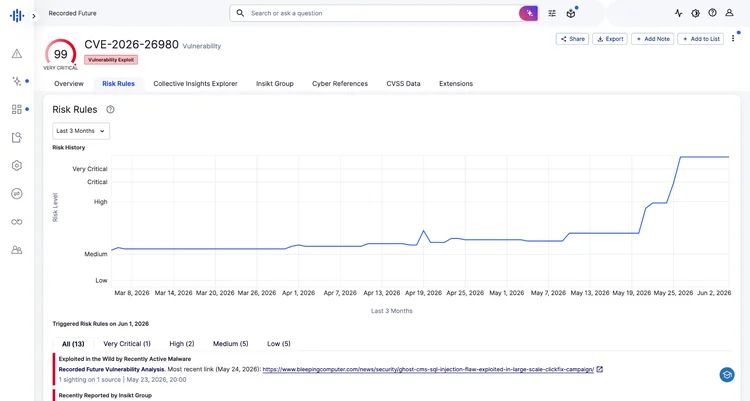
- Threat actors effectively leveraged a vulnerability within Ghost CMS (CVE-2026-26980) for extensive ClickFix and FakeCaptcha campaigns leveraging compromised websites.
- 12 vulnerabilities facilitated remote code execution (RCE), affecting diverse vendors such as Microsoft, Adobe, and Palo Alto Networks. If you're working in this space, this mix of vendors highlights a widespread risk.
- Insikt Group reported public proof-of-concept (PoC) exploits for 32 reported vulnerabilities this month, indicating an increased ease in exploitability. What this means for you is that developers need to be attuned to security patches more than ever.
- The most prevalent vulnerability types included CWE-79 (Cross-site Scripting), CWE-506 (Embedded Malicious Code), and CWE-89 (SQL Injection), with three CVEs identified for each. This information is pivotal for organizations, as it outlines the types of attacks that are gaining traction.
- Five vulnerabilities, dating back as far as 2008, showcase the persistent risk associated with long-neglected issues in cybersecurity management. This underlines a sobering reality: many vulnerabilities can remain open for years, potentially waiting for the right moment for an attacker to exploit.
Deep Dive: CVE-2026-26980
Highlighting the severity of exploitations, cybersecurity firm XLab disclosed a major report on May 21, detailing the exploitation of CVE-2026-26980, which affects Ghost CMS. This vulnerability enables unauthorized actors to extract admin API keys, allowing them to manipulate content on compromised sites. Such a wide-reaching exploit illustrates how critical it is for organizations to maintain updated security practices and monitor for vulnerabilities continuously.
According to XLab, attack groups have specifically utilized this vulnerability to implement ClickFix and FakeCaptcha payloads across over 700 websites, targeting sectors including blockchain and fintech. (and this is the part most people overlook) The result is a cascading effect where compromised sites can further jeopardize user data and trust. Insikt Group managed to capture a malicious sample termed UtilifySetup.exe for analysis, which shows sophisticated behavior indicative of malicious intent and significant evasion tactics.
Malware Sample Analysis
The analyzed UtilifySetup.exe revealed multiple harmful actions, including:
- DLL injection capabilities.
- System language and geolocation retrieval through registry access.
- File creation within user directories to persist across sessions.
This sample exemplifies the orchestration between exploitation and malware deployment, demonstrating how vulnerabilities can be weaponized swiftly and effectively by threat actors. As we've seen in numerous cases, the technical capabilities of malware today can significantly outpace the remedial actions organizations take to counter them.
Implications and Future Outlook
The increase in identified vulnerabilities isn't just alarming; it poses a structural challenge to cybersecurity frameworks. Organizations that fail to adopt a diligent approach towards vulnerability management may find themselves faced with consequences that extend beyond financial losses. The reputational damage can be irreparable. Security teams are under tremendous pressure to monitor, patch, and respond as threats evolve quickly.
As cyber threats become more sophisticated, the importance of adopting proactive vulnerability management strategies is amplified. Traditional methods may not be enough as threat actors seem to be weaponizing old exploits with new efficiency. Therefore, organizations must consider investing in continuous training for their staff, regular audits of their systems, and deploying more inclusive response strategies. This isn't just about fixing problems; it's about creating a resilient infrastructure prepared to handle what’s next.